Oracle Fusion Agentic Applications and Fusion Claw
A New Direction for Enterprise Applications
Enterprise AI is moving beyond answering questions and supporting individual tasks. Organizations are increasingly exploring how AI can coordinate multi-step work across business applications while respecting policies, approvals, and security requirements. Oracle’s October 26, 2026 announcement at Oracle AI World reflects this shift with Oracle Fusion Agentic Applications powered by Oracle Fusion Claw.
Oracle describes Fusion Agentic Applications as outcome-driven applications that coordinate work toward defined business objectives. People set the objectives, authority, and accountability; the applications coordinate the steps required to progress toward those outcomes.
What Is Oracle Fusion Claw?
Oracle Fusion Claw is the governed agentic execution runtime that powers these applications. It supports complex, specialist-grade work through reasoning, computation, simulation, modeling, continuous replanning, and deterministic execution. It provides the execution foundation for agentic applications to manage longer-running work within organizational policies and controls.
An AI assistant may provide a recommendation or answer, while an agentic application can coordinate a sequence of business activities and carry out authorized actions through enterprise workflows. Human oversight, approvals, and accountability remain part of the operating model.
Where Fusion Agentic Applications Fit: ERP, HCM, and SCM
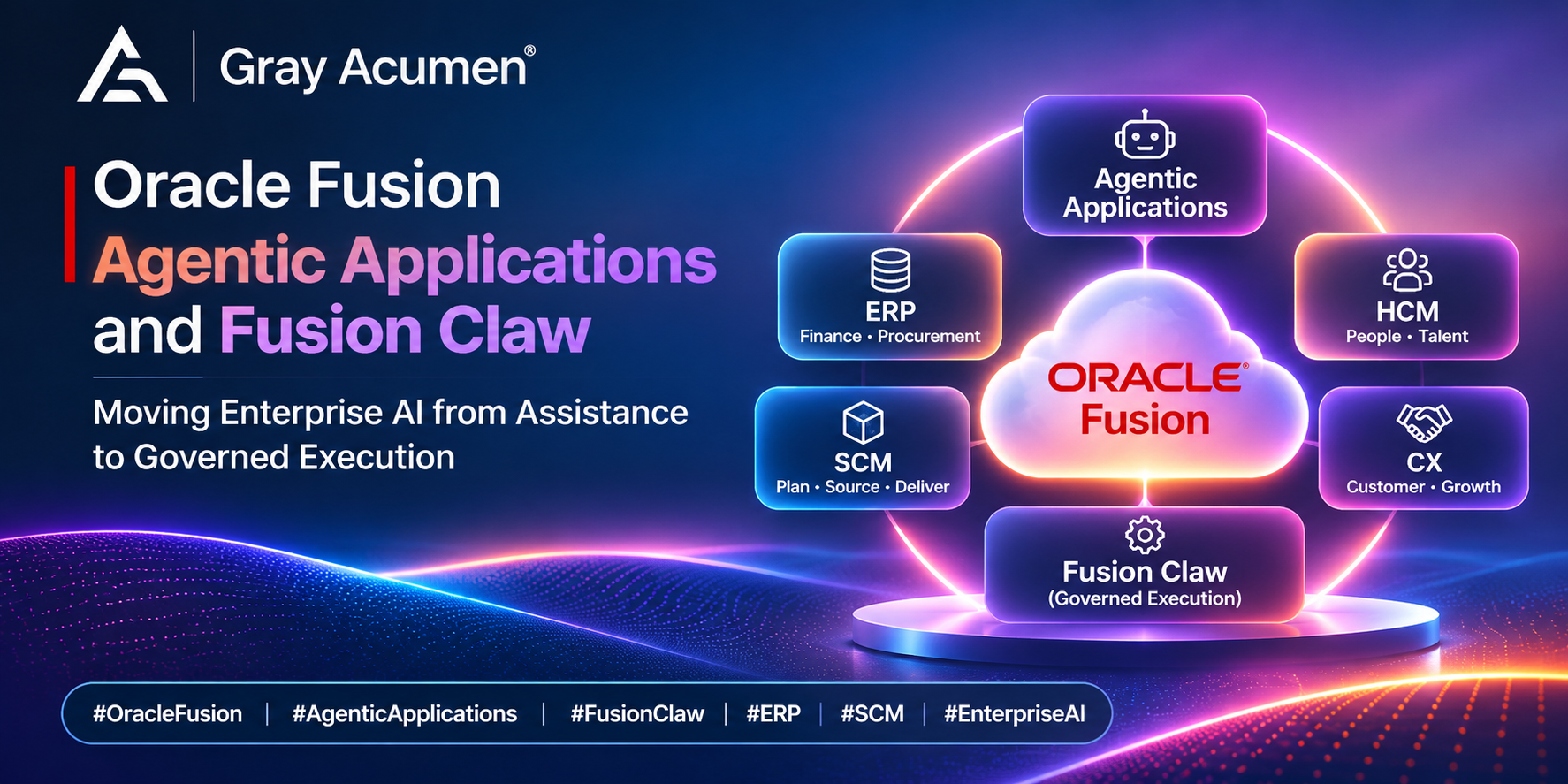
Oracle announced 25 Fusion Claw-powered Agentic Applications across Oracle Fusion Cloud ERP, HCM, SCM, and CX. This connects the technology directly to core enterprise operations—not just standalone AI experimentation.
In finance and ERP, the Ledger application can help improve close readiness by reconciling accounting information, investigating exceptions and anomalies, and performing complex analysis. Execution remains subject to authorization and organizational controls.
In supply chain and manufacturing, agentic applications can support planning and operational decisions. Planning activities can consider demand changes, cost, capacity, and continuity, then coordinate next steps for review and approval. Across procurement, inventory, manufacturing, and logistics, the opportunity is to connect information and actions across processes.
In HCM, applications can help with workforce planning and payroll-related activities. Across CX, the portfolio extends the same outcome-driven approach to sales and service processes.
Why This Matters for Oracle ERP and SCM Customers
ERP and SCM processes are closely connected. Procurement affects budgets and payables; inventory movements influence valuation and financial reporting; and supply chain execution affects customer commitments, revenue, and working capital. Disconnected information can make it difficult to understand the full business impact of an issue.
Fusion Agentic Applications aim to coordinate work across enterprise processes using Fusion business context, workflows, and controls. The opportunity is to reduce manual coordination, investigate exceptions faster, and move toward more connected decision-making. Actual results depend on process design, data quality, configuration, and organizational readiness.
From User Intent to Coordinated Action
Oracle also introduced Fusion Companion and Fusion Agentic Home to connect business objectives with execution. Users can describe what they want to accomplish, delegate work to agents or agentic applications, and track progress. Fusion Companion uses enterprise context, data, and user permissions to coordinate appropriate transactions, workflows, approvals, and agents.
This creates a different way to interact with enterprise software: instead of navigating each step manually, users can express an objective and monitor the work as it progresses. The system remains bounded by permissions and controls established by the organization.
Governance Is Essential
More autonomous execution makes governance more important. Organizations need to define which data agents can access, what actions they can perform, which activities require approval, and how execution is recorded. Oracle states that Fusion Agentic Applications operate within organizational policies, controls, and authority, with approvals and traceability supporting accountable execution.
For ERP and supply chain environments, this matters because actions can affect financial records, supplier relationships, inventory availability, customer commitments, and workforce operations. AI adoption should be planned around clear ownership, testing, security, and human review.
What Businesses Should Consider
- Start with a business outcome: Choose a measurable challenge such as faster financial close, better planning, or improved exception handling.
- Review process and data readiness: Check data quality, integrations, workflows, roles, and approval paths before introducing agentic execution.
- Set clear boundaries: Define permissions, escalation rules, human approvals, and audit requirements.
- Measure performance: Track cycle time, exception resolution, process consistency, and business impact.
How Gray Acumen Can Support the Journey
At Gray Acumen, we believe successful adoption of Oracle innovation starts with understanding customer business processes and the existing Oracle environment. As organizations evaluate Oracle Fusion ERP, SCM, and emerging agentic capabilities, it is important to assess process readiness, integrations, data, security, and governance together. This helps build a practical roadmap aligned with business priorities.
Looking Ahead
Oracle Fusion Agentic Applications and Fusion Claw point toward enterprise software that can do more than record transactions or provide recommendations. They are designed to coordinate and execute work toward defined outcomes, with people retaining authority and accountability. For Oracle ERP and SCM customers, the next step is to identify where this approach can simplify complex processes, improve operational visibility, and deliver measurable value.
-by grayacumen