The Future of Enterprise AI: Connecting Investment with Business Impact
AI Investment Is Reshaping the Business Landscape
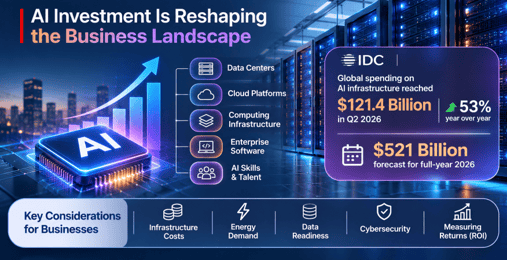
Artificial intelligence is moving from experimentation into large-scale business investment. Across the United States, organizations are committing resources to data centers, computing infrastructure, cloud platforms, enterprise software, and the skills needed to apply AI in daily operations. This creates new opportunities, but it also raises practical questions about infrastructure costs, energy demand, data readiness, cybersecurity, and how companies will measure returns.
IDC reported that global spending on AI infrastructure reached $121.4 billion in the second quarter of 2026, up 53% year over year, and forecast full-year spending of $521 billion. The scale of this investment highlights how quickly the foundations for AI are expanding. For business leaders, the next challenge is converting infrastructure and technology spending into measurable improvements across the enterprise.
From AI Infrastructure to Operational Value
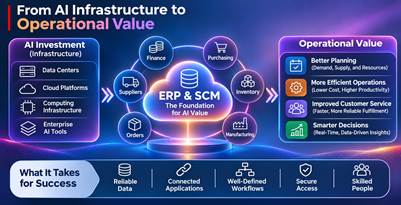
AI investment creates business value when it improves the way an organization plans, operates, serves customers, and makes decisions. This requires more than selecting an AI tool. Companies need reliable data, connected applications, well-defined workflows, secure access, and people who understand how to use new capabilities responsibly.
Enterprise resource planning (ERP) and supply chain management (SCM) are important parts of this foundation. They hold and connect information about finance, purchasing, suppliers, inventory, manufacturing, orders, and business performance. When these systems are integrated and their data is dependable, AI initiatives can be based on a more complete view of the organization.
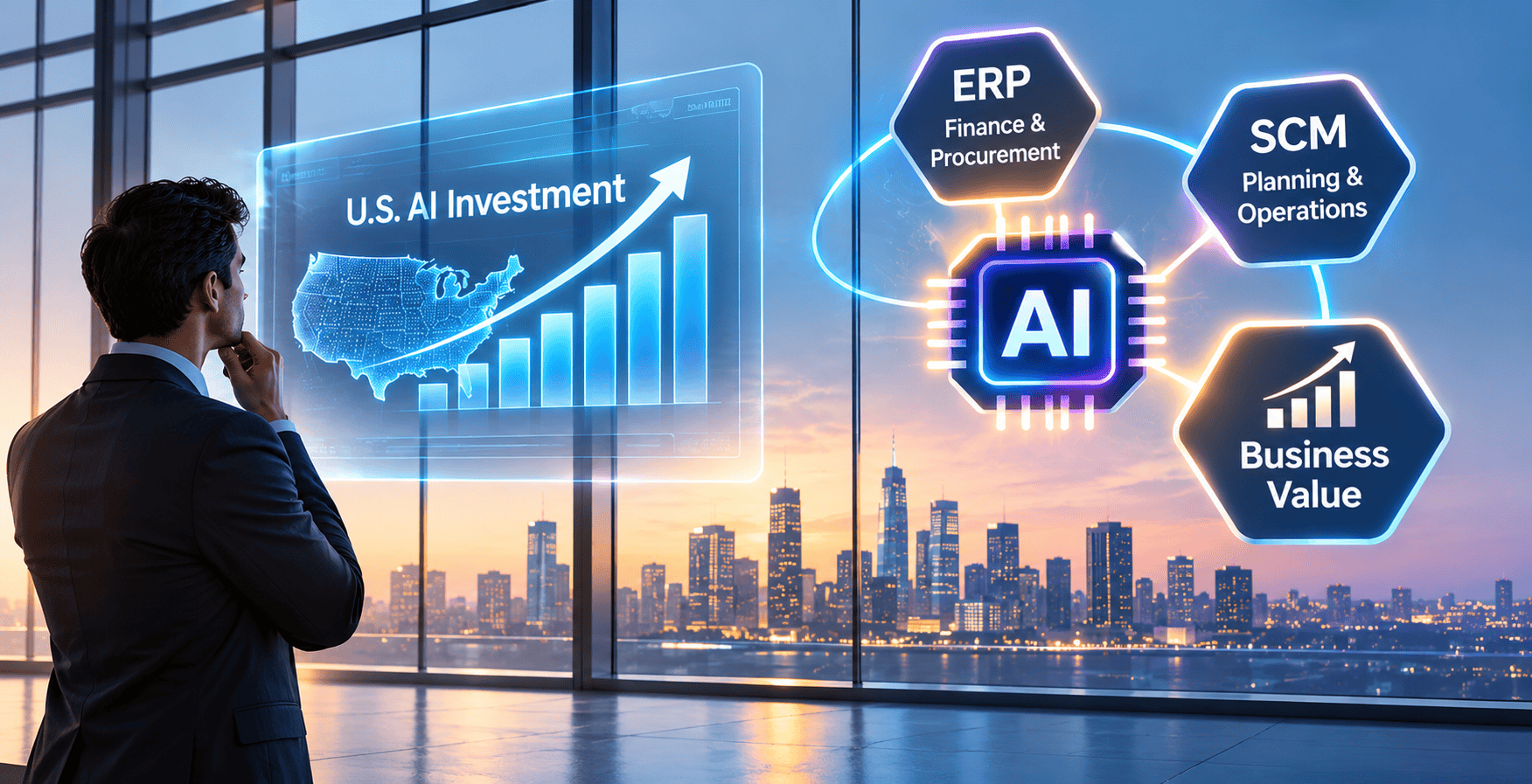
Why ERP Matters in an AI-Driven Business
ERP provides the operational and financial backbone of an organization. Finance teams rely on accurate transaction data for accounting, budgeting, reporting, and financial close. Procurement teams need visibility into spending, suppliers, and approvals. Operations leaders need consistent information to understand costs and business performance.
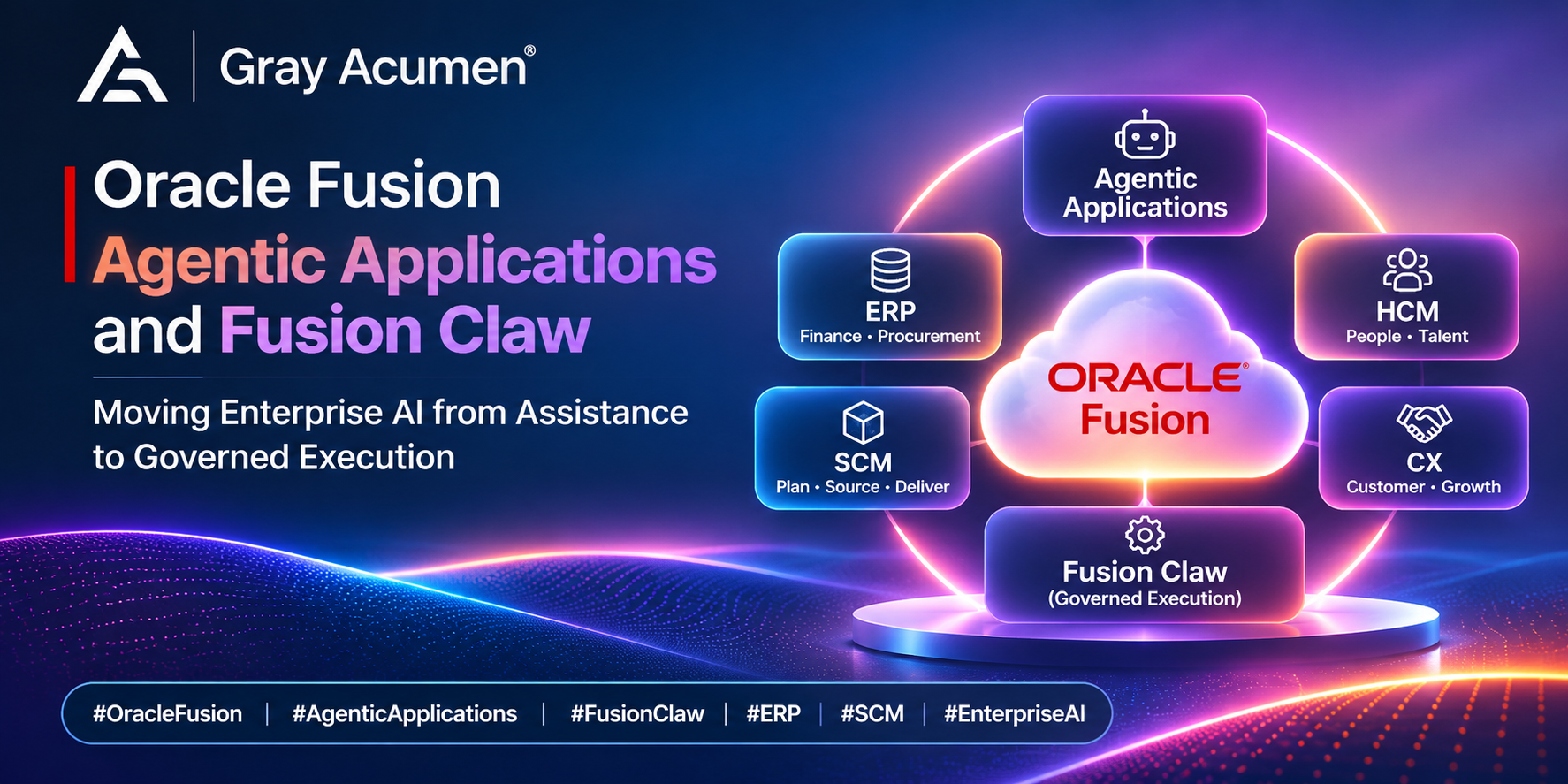
With Oracle Fusion Cloud ERP, organizations can modernize core finance and procurement processes and establish a connected foundation for analytics and AI-enabled workflows. For example, AI-supported analysis may help identify unusual transactions, highlight patterns in expenses, or bring attention to exceptions that require review. The goal is not to remove financial controls or human judgment, but to help teams focus attention where it is most valuable.
Why SCM Is Equally Important
Supply chain performance depends on coordinating demand, suppliers, purchasing, inventory, manufacturing, warehousing, and order fulfillment. Disruptions, changing customer demand, or limited supplier visibility can affect costs and delivery commitments. Disconnected systems make it harder to understand these impacts early.
Oracle Fusion Cloud SCM can provide a connected environment for supply chain planning, procurement, inventory, manufacturing, and order management. When supported by quality data and appropriate integrations, analytics and AI can help teams identify demand changes, review inventory positions, assess supplier risks, and evaluate planning scenarios. These insights can support better-informed decisions, while business owners retain approval over important actions.
Connecting ERP and SCM: A Stronger Enterprise View
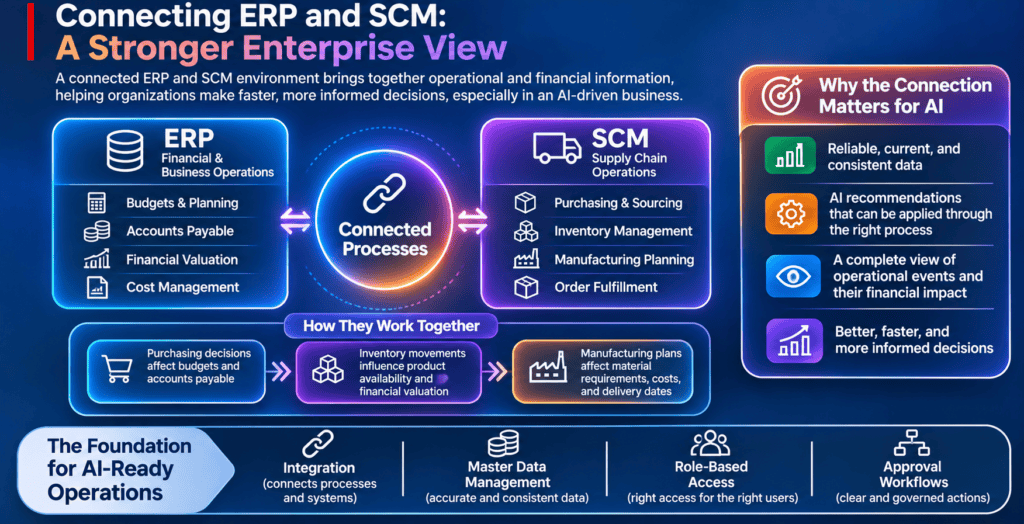
ERP and SCM should not be treated as separate technology investments. A purchasing decision affects budgets and accounts payable; inventory movements influence product availability and financial valuation; manufacturing plans affect material requirements, costs, and delivery dates. Connecting these processes helps organizations understand both the operational event and its financial impact.
For businesses investing in AI, this connection is especially important. An AI-generated recommendation is only useful when it is based on current, consistent information and can be applied through the right business process. Integration, master data management, role-based access, and clear approval workflows help create that foundation.
How Businesses Can Prepare
- Identify high-value use cases: Start with specific challenges such as slow financial close, manual procurement checks, excess inventory, or limited demand visibility.
- Assess ERP and SCM readiness: Review processes, configurations, integrations, data quality, and reporting before introducing AI.
- Connect enterprise information: Reduce data silos across finance, procurement, inventory, manufacturing, and other applications.
- Build in governance: Define access permissions, approval points, security requirements, and human oversight for AI-supported work.
- Measure business outcomes: Track relevant indicators such as close cycle time, inventory accuracy, forecast performance, procurement efficiency, and exception resolution.
How Gray Acumen Can Help Organizations Navigate the AI Shift
At Gray Acumen, we help organizations plan and advance their Oracle technology initiatives, with a focus on implementation, licensing, and enterprise solutions. As businesses evaluate AI investments, we can help them look beyond the technology itself and assess the Oracle environment, business processes, and integration requirements that support successful adoption.
This can include helping customers evaluate and implement Oracle Fusion Cloud ERP and SCM capabilities, align finance and supply chain processes, and identify where integrations can improve the flow of information between systems. We can also support ongoing application needs through managed services and help organizations consider cloud and multicloud strategies as their technology environments evolve.
Our approach starts with understanding the customer’s goals and current challenges. From there, we can help define a practical roadmap—prioritizing process improvements, data and integration readiness, appropriate Oracle capabilities, security, and governance. The objective is to make AI adoption purposeful, connected to business needs, and supported by a strong enterprise foundation.
Turning Investment into Sustainable Business Outcomes
The AI investment boom in the United States signals a major shift in technology and business strategy. However, long-term value will depend on how effectively organizations connect AI with the systems and processes that run their operations. A modern ERP foundation, integrated supply chain, trusted data, and clear governance can help businesses move from isolated experiments toward practical enterprise use.
For organizations using or considering Oracle Fusion Cloud ERP and SCM, now is the time to assess readiness, strengthen core processes, and identify business problems where intelligent capabilities can make a measurable difference. With the right planning and implementation support, AI investment can become a driver of operational resilience, visibility, and sustainable growth.
Conclusion: Turning AI Investment into Business Value
The AI investment boom is creating new opportunities for businesses, but long-term value will depend on how effectively organizations connect technology with everyday operations. A strong foundation in Oracle Fusion ERP and SCM, supported by reliable data, well-planned integrations, and clear governance, can help businesses improve visibility across finance and supply chain activities and make more informed decisions. By preparing their systems, processes, and people before introducing AI-enabled workflows, organizations can move beyond experimentation and focus on measurable outcomes such as operational efficiency, cost control, planning accuracy, and better service. Gray Acumen can support this journey through Oracle implementation and licensing guidance, ERP and SCM process alignment, integration planning, managed services, and cloud strategy—helping businesses build a practical foundation for the next phase of enterprise transformation.
– by Gray Acumen