Beyond Skills Intelligence: Building a Skills-Based Workforce with Oracle Fusion HCM
Introduction
Organizations are becoming increasingly aware that workforce planning cannot stop at identifying skills gaps. Knowing which skills exist in the workforce, which capabilities are missing, and which skills may become important in the future is only the beginning. The next challenge is turning that information into action.
This is the shift from skills intelligence to skills-based talent management. Instead of treating recruiting, learning, performance, career development, and internal mobility as separate HR activities, organizations can connect them through a common understanding of workforce skills.
Oracle Fusion Cloud HCM supports this approach through capabilities such as Oracle Dynamic Skills, which provides a common skills language and connects skills-informed hiring, skills-driven learning, strategic upskilling, career mobility, workforce planning, and role alignment.
From Skills Intelligence to Action
The previous stage of the workforce transformation journey focused on creating visibility. Organizations wanted to understand what skills their employees had, where gaps existed, and how those capabilities aligned with future business requirements.
The next stage is action. Once a skills gap is identified, leaders need to determine the most effective way to address it. The answer may be external hiring, internal mobility, targeted learning, reskilling, or a combination of these approaches.
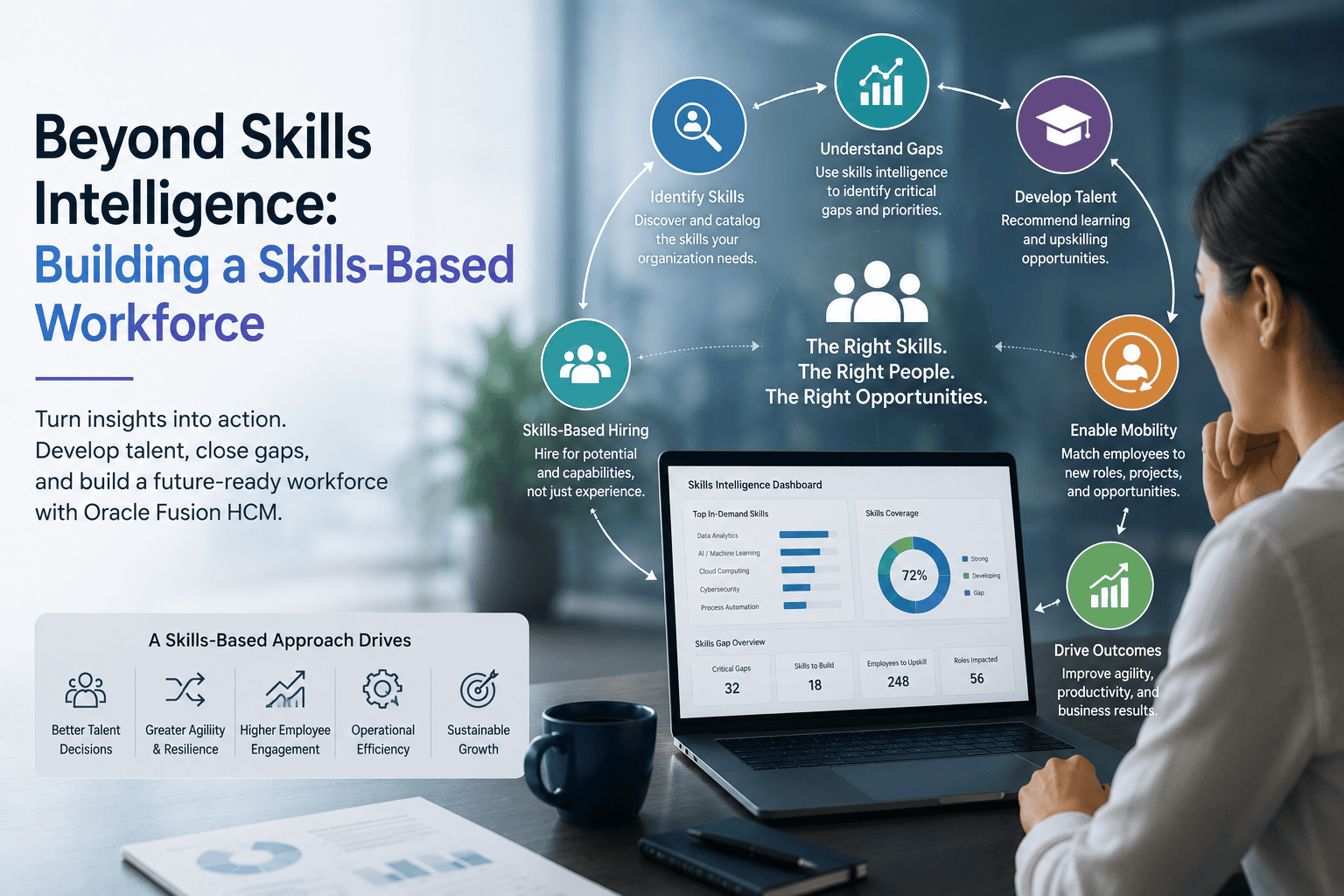
This creates a practical cycle:
Identify Skills → Understand Gaps → Decide on Action → Develop or Acquire Talent → Measure Outcomes
A skills-based talent strategy therefore moves workforce management away from simply recording employee information and toward continuously connecting people, skills, opportunities, and business needs.
Building a Skills-Based Talent Strategy
A skills-based talent strategy focuses on capabilities rather than relying only on job titles, organizational structures, or historical workforce patterns. This does not mean that roles and positions become irrelevant. Instead, skills provide an additional layer of intelligence that helps organizations understand what people can do and what they may be able to do next.
A modern skills-based strategy can connect:
- Skills-informed recruiting
- Employee learning and development
- Career development
- Internal mobility
- Strategic workforce planning
- Performance and talent discussions
- Succession and workforce readiness
Oracle Dynamic Skills is designed to support this connected approach by creating a common skills language and bringing skills intelligence into recruiting, learning, career mobility, planning, and other talent processes.
Connecting Employees With the Right Opportunities
One of the most valuable applications of skills intelligence is helping organizations understand where existing employees may fit within emerging opportunities.
An employee may not have every skill listed in a new role, but they may already possess several adjacent capabilities that make them a strong candidate for development. A skills-based approach can help managers and employees look beyond exact job-title matches and consider transferable capabilities.
This can support opportunities such as:
- New internal roles
- Short-term projects and assignments
- Learning opportunities
- Career pathways
- Cross-functional opportunities
- Emerging roles created by digital transformation
Oracle’s Dynamic Skills capabilities include skills-informed career mobility and a centralized Skills Center where employees can explore skills, development, connections, and growth opportunities.
Skills-Based Recruiting
External hiring remains an important part of workforce strategy, particularly when organizations face critical capability shortages. However, recruiting can become more effective when hiring decisions are based on the skills required to succeed rather than job titles alone.
Skills-informed recruiting can help organizations identify the capabilities needed for a requisition, compare candidate skills with role requirements, and make the search for relevant talent more focused.
This can be particularly valuable for emerging roles where traditional job titles and career histories do not always provide a complete picture of a candidate’s capabilities.
Oracle Dynamic Skills includes skills-informed hiring capabilities designed to help recruiting teams identify skills for requisitions and job descriptions and support skills-based candidate matching.
Learning and Development Based on Skills Gaps
Hiring is not always the best answer to a skills shortage. In many cases, organizations already have employees with the potential to develop the required capabilities.
Connecting skills intelligence with learning allows organizations to move from generic training programs toward more targeted development. If an employee has several of the skills required for a future role, the organization can identify the remaining capabilities and recommend development opportunities.
Oracle’s skills-driven learning capabilities are designed to recommend relevant development opportunities based on business objectives and an employee’s role, interests, and career aspirations. Oracle Grow also connects learning, skill development, and career mobility within the HCM environment.
The result is a continuous development cycle:
Skills → Gap → Learning → Development → New Capability → Opportunity
Internal Mobility: Unlocking Existing Talent
Internal mobility is becoming an increasingly important part of workforce strategy because organizations often have more talent available internally than they realize.
Employees may possess transferable skills that are not visible through their current job title. A person working in one function may have analytical, project management, technology, communication, or leadership capabilities that could be valuable in another part of the organization.
Skills-based internal mobility can help organizations identify these possibilities and create clearer career pathways. It can also give employees greater visibility into how their current capabilities can support future career growth.
Oracle Dynamic Skills supports skills-informed career mobility, while its Opportunity Marketplace and related capabilities can help connect people with opportunities based on skills and development.
AI and Skills-Based Talent Management
Artificial intelligence is becoming an important enabler of skills-based talent management. Rather than requiring employees and HR teams to manually maintain every skills relationship, AI can help identify, infer, recommend, and match skills across people, roles, learning, and opportunities.
Oracle’s current Dynamic Skills capabilities use organizational data to automatically identify, infer, and recommend skills for people, jobs, and other skills-related resources. Oracle also provides AI-based matching of people, jobs, and resources using contextual similarity rather than relying only on exact keyword matches.
Oracle’s 2026 HCM updates also show the broader direction of the platform. New AI agents and Fusion Agentic Applications for HR are being introduced to help organizations accelerate employee development, strengthen internal mobility, and respond to changing skills needs.
The important point is that AI should support better talent decisions—not replace human judgment. HR leaders, managers, and employees still need appropriate governance, context, and oversight when making decisions about careers, development, and workforce planning.
The Middle East Perspective
The move toward skills-based talent management is particularly relevant for organizations across the Middle East. Regional businesses are investing in digital transformation, cloud technologies, AI, and new operating models, creating demand for capabilities that may not have been as important in traditional workforce structures.
For organizations operating across multiple countries and diverse workforces, a common skills framework can also help create greater consistency in how talent is identified, developed, and deployed.
A skills-based approach can help Middle East enterprises address several practical priorities:
- Identifying emerging digital and AI capabilities
- Reducing dependence on reactive hiring
- Improving internal talent utilization
- Creating clearer career pathways
- Supporting continuous upskilling and reskilling
- Improving workforce readiness for new business models
- Connecting talent strategy with broader digital transformation goals
Why Data Quality and Governance Still Matter
Skills-based talent management depends on trustworthy data. If employee profiles are outdated, job requirements are inconsistent, or skills are recorded differently across departments, the resulting recommendations may not provide a reliable picture of workforce capability.
Organizations should therefore establish:
- A consistent skills language
- Clear ownership of workforce data
- Regular skills and profile updates
- Appropriate access controls
- Data quality monitoring
- Governance for skills definitions and taxonomies
- Integration between HCM, learning, recruiting, and workforce planning processes
Oracle Dynamic Skills includes a common skills language and a single source of skills information, supporting a more consistent foundation for skills-based decisions.
Measuring the Business Impact
A skills-based strategy should ultimately produce measurable business outcomes. Organizations should look beyond the number of skills recorded and evaluate whether skills intelligence is improving how talent is acquired, developed, and deployed.
Useful measures can include:
- Reduction in critical skills gaps
- Internal mobility rates
- Time to fill critical positions
- Employee retention
- Learning and development outcomes
- Skills gained or improved
- Hiring efficiency
- Workforce productivity
- Readiness for future roles
Oracle HCM Analytics provides workforce insights that can help organizations analyze skills, identify gaps, and support decisions around career paths, projects, recruitment, upskilling, and workforce planning.
How Gray Acumen Can Help
Moving toward skills-based talent management requires more than enabling a technology capability. Organizations need to align people, processes, data, integrations, and technology around a clear workforce strategy.
Gray Acumen can support organizations across their Oracle Fusion HCM journey, including HCM implementation, talent management, workforce planning, integration strategy, analytics, testing, optimization, and managed services.
The objective is to help organizations build an HCM environment where skills intelligence can translate into practical workforce actions—from hiring and learning to career mobility and strategic planning.
Looking Ahead
The future of talent management is moving toward continuous alignment between people, skills, opportunities, and business strategy.
As skills continue to evolve, organizations will need talent systems that can adapt with them. The goal is not to create a static skills database, but to build an environment where workforce capabilities can be continuously understood, developed, matched, and applied.
Oracle’s continued investment in Dynamic Skills, AI-powered recommendations, learning, career mobility, analytics, and agentic HCM capabilities reflects this broader shift.
Conclusion
Skills intelligence creates visibility. Skills-based talent management turns that visibility into action.
Organizations that understand their workforce skills can make more informed decisions about where to hire, where to invest in learning, which employees can move into new opportunities, and which capabilities will be needed next.
For Middle East enterprises navigating rapid digital transformation, this approach can help create a workforce that is more agile, adaptable, and prepared for changing business requirements.
The future-ready organization will not simply ask, ‘How many people do we need?’ It will ask a more strategic question:
“What skills do we need, where can we find them, and how can we build them?”
That is the shift from managing positions to building capabilities—and from skills intelligence to a truly skills-based workforce.
-by grayacumen